larger (700W and more) and much more efficient.
Solar panels are priced per watt, and interestingly, the larger the panel, the less
expensive it is per watt. It is not surprising to pay more for a 275W panel than for a
500W panel.
Most large panels are bifacial, meaning they capture light through the back of the
panel. Depending on reflection (especially from snow in winter), the gain can be between
5 and 25%. This must therefore be taken into account when configuring the solar system in relation to the
capacity of the inverter or charge controller.
Panels also perform better in winter: cold improves cell efficiency,
with gains of 7 to 10% when the temperature drops from 25°C to 0°C. At -20°C they can
produce up to 15% more per hour of sunshine. The colder it is, the better they perform.
Unfortunately, there are fewer daylight hours, and in December the sun is
lower on the horizon, which offsets the greater efficiency in winter.
Both factors really must be taken into account: reflection and cold. In January, February and
March, the days begin to lengthen and the sun is higher. It is not unusual to have
days with a beautiful blue sky from morning to evening. The energy produced by the panels can
exceed the charge controller's capacity to absorb the excess energy and damage it.
One way to solve the problem is to use more energy, but we are not
always on site to take advantage of this surplus.
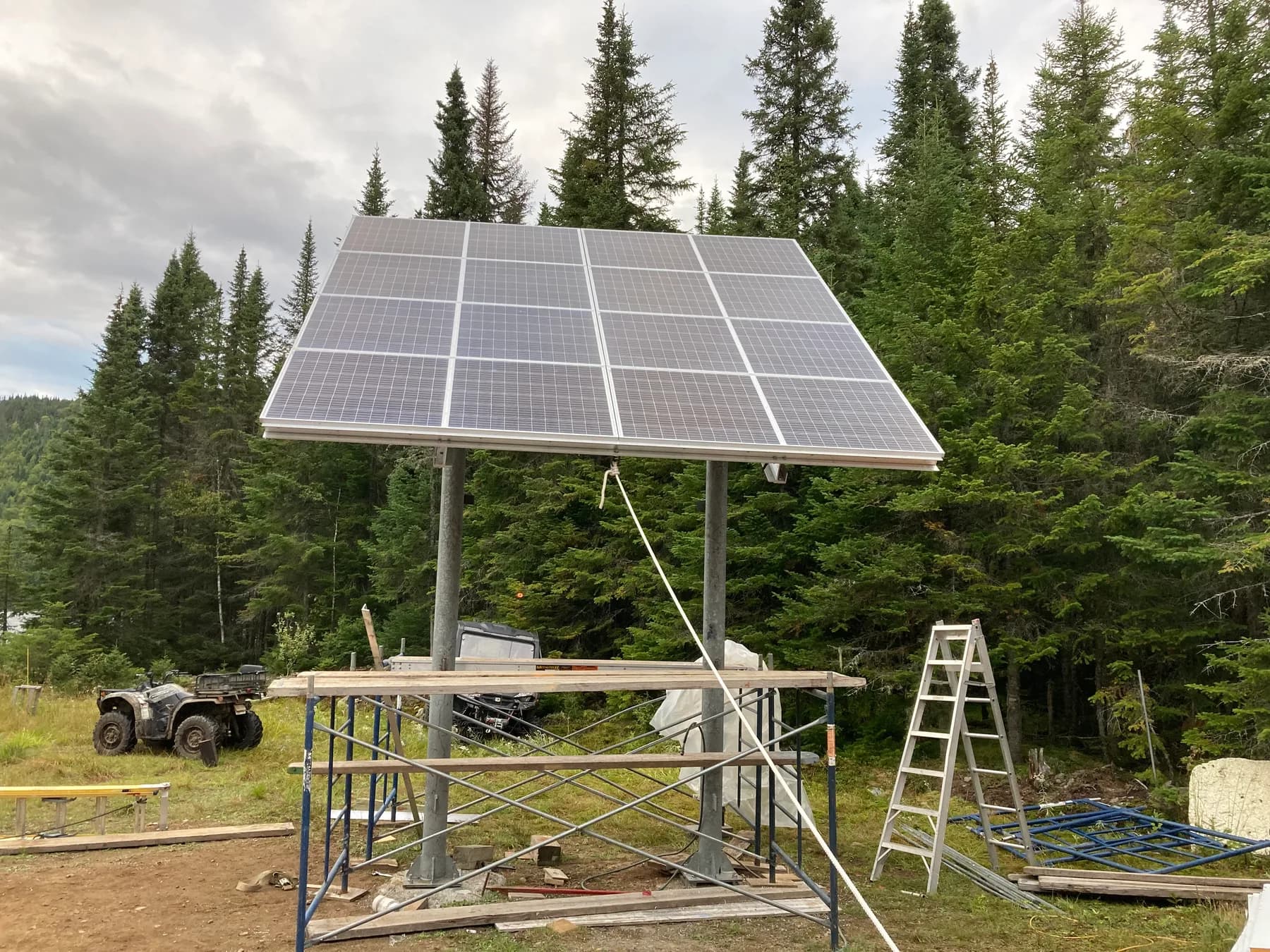
Will your panels be installed at an angle in the middle of a field on a beautiful
day when freshly fallen snow sparkles with reflected sunlight? Allow for a
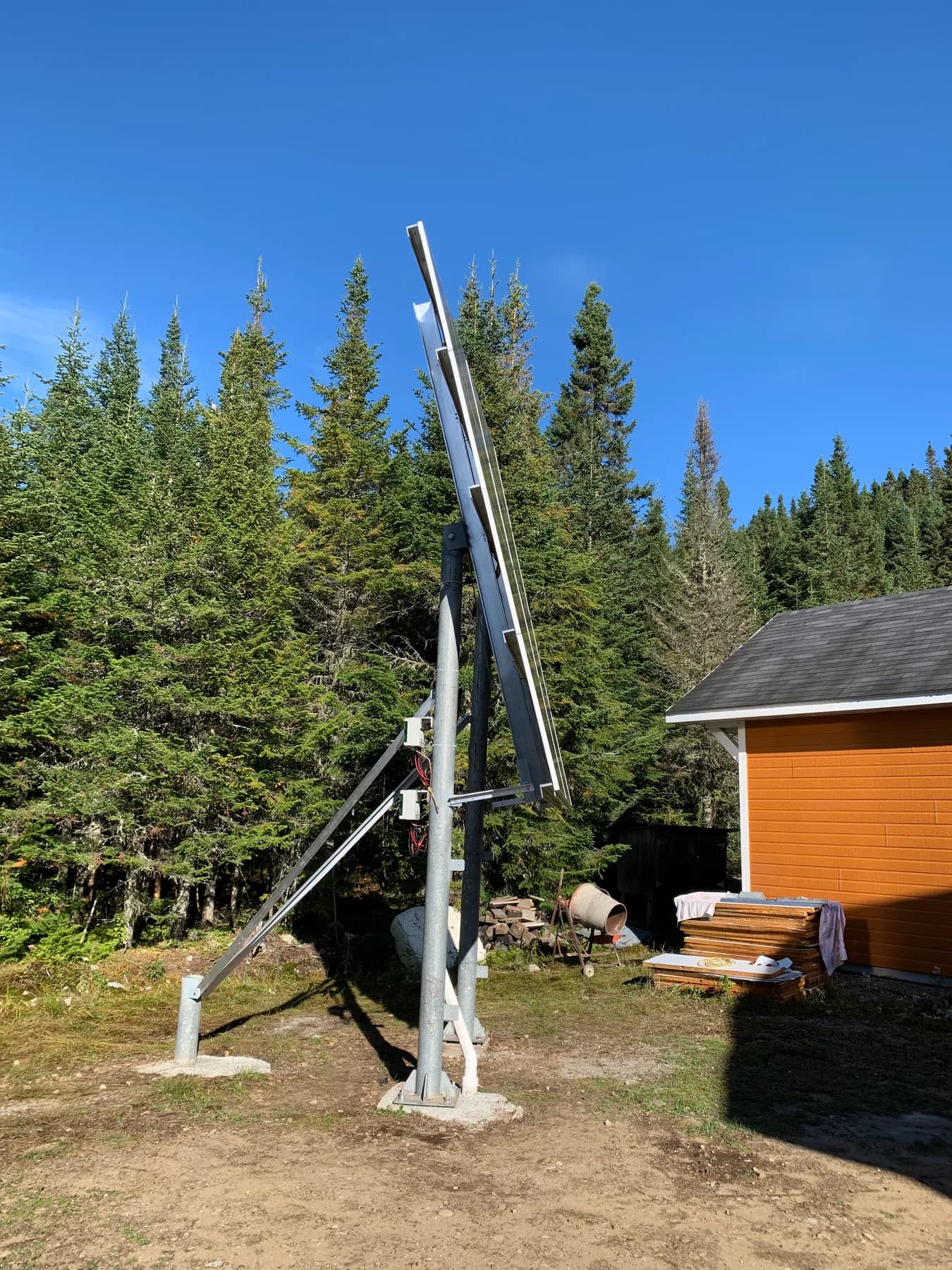
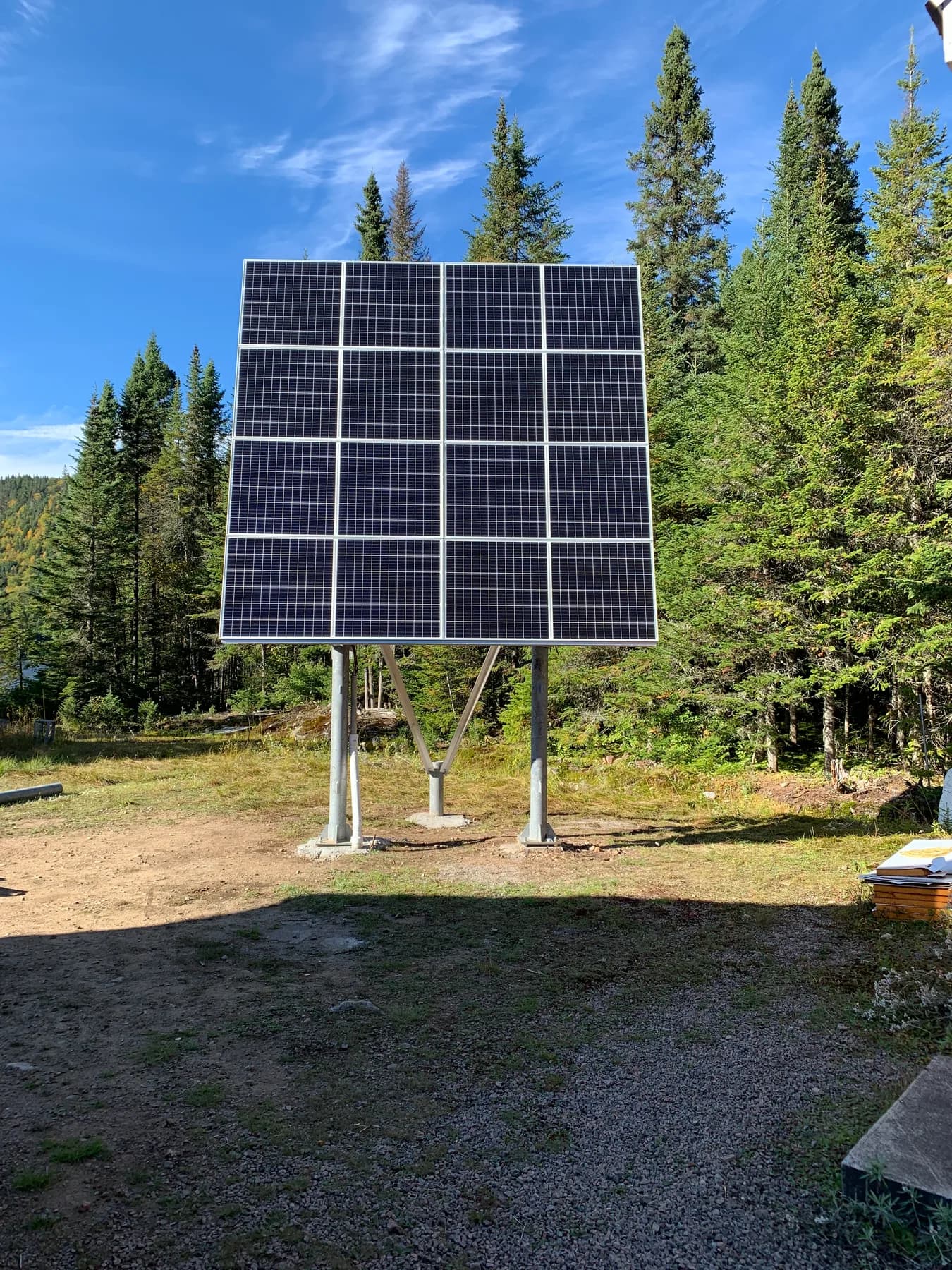
25% reflection gain. Are your panels installed vertically to prevent the accumulation of
snow, resulting in less reflection? If you look at some of our installations, you will notice
that our panels are installed vertically. Over time, we have realized
that it is more important to keep them vertical because no snow accumulates on
the panels. With shorter days, waiting for the snow to melt reduces daily
production even further...
As explained in the solar system blog post, there are all sorts of constraints when choosing
where to put the panels: on the roof, on a ground mount, on a wall, and so on.
If you do not have sunlight all day and need to prioritize a location where they will be
exposed to sunlight without any shading for a shorter period during the day, you
need to install more panels if possible and choose a larger inverter to have enough time to charge
your batteries.
Panels can be installed in series, in parallel, or in a combination of both. In
series, the voltages add up but the amperage remains unchanged. In parallel, the voltage stays the
same but the amperage doubles. All our SRNE inverters operate with an open-circuit
voltage between 500 and 550Vdc. We therefore favour installation in series. The larger
Solar Panels
inverters have charge controllers to which strings of
panels can be connected in parallel. Their input current capacity (Isc/A) is then higher.
How to determine the number of panels based on the inverter:
You need to consult the datasheet and look for the following information:
• Maximum Power (Pmax/W) / Maximum power in watts
• Open Circuit Voltage (Voc/V) / Open-circuit voltage
• Short Circuit Current (Isc/A) / Short-circuit current
Take the Longi 540W bifacial panel as an example, with an estimated gain of 15%:
Look in the section entitled "Electrical characteristics with different rear side power
gain", which gives the electrical characteristics at different levels of rear-side power gain:
• Pmax/W: 621 W (the 540W panel with an additional 15% produces 621W)
• Voc/V: 49.6V
• Isc/A: 15.92A
Take a 6.5Kw SRNE off-grid inverter as an example, with two MPPT charge
controllers.
• Each controller can support 5000W + 5000W
• The open-circuit voltage (Voc/V) is 550Vdc + 550Vdc
• The maximum input current (Isc/A) is 18A + 18A
We immediately see that we cannot put the panels in parallel because
we would exceed the maximum input current capacity of 18A. The panel Isc/A is
15.92, multiplied by 2 equals 31.84A when connected in parallel.
Therefore:
• 5000 divided by 621W = 8 panels per charge controller
• 8 multiplied by 49.6V = 396.8Vdc, which is below the maximum of 550VDC
• Since we are connected in series, the current remains at 15.92A
In conclusion, for an SRNE6.5Kw inverter, you can install 16 panels of 540W (2 groups of 8,
one on each controller), with a 15% allowance for extra production due to reflected sunlight.