As explained in an earlier blog post, batteries are the most expensive part of a solar system. It is important to make the right choice based on your needs, the location, and the quality of the batteries.
In this blog post, we will discuss only sealed batteries: AGM, GEL and lithium. The descriptions below are provided for information, in the hope of helping you make your choice. For more technical information specific to each battery, please contact us.
All batteries are made up of 2V cells. You will therefore find 2V, 6V, 12V, 24V and 48V batteries on the market. You can make certain combinations. Examples:
24V system:
• 12 batteries of 2V connected in series equal 24V
• 4 batteries of 6V connected in series equal 24V
• 2 batteries of 12 V connected in series equal 24
When batteries are connected in series, the voltage doubles but the amperage stays the same.
When batteries are connected in parallel, the voltage stays the same but the amperage doubles.
Whether AGM, GEL or lithium, the life of a battery is determined by the number of discharge and recharge cycles and its environment (temperature).
For one cycle, the battery must be discharged by 100%:
Therefore:
• Discharging by 25% equals 0.25 of a cycle
• Discharging by 10% equals 0.10 of a cycle
• Discharging by 50% equals 0.50 of a cycle
• Discharging by 100% equals 1 cycle.
Example: if you discharge your batteries by 25% every day for one year, you will have completed 91.5 cycles (365/4 = 91.5).
Batteries
Unfortunately, the number of cycles is not the only factor in battery life.
The biggest influence is temperature. The higher it is, the shorter your battery will last.
Over time, the internal components become less effective, which inevitably reduces service life. Even a battery in storage loses capacity over time.
Lithium (LFP) batteries:
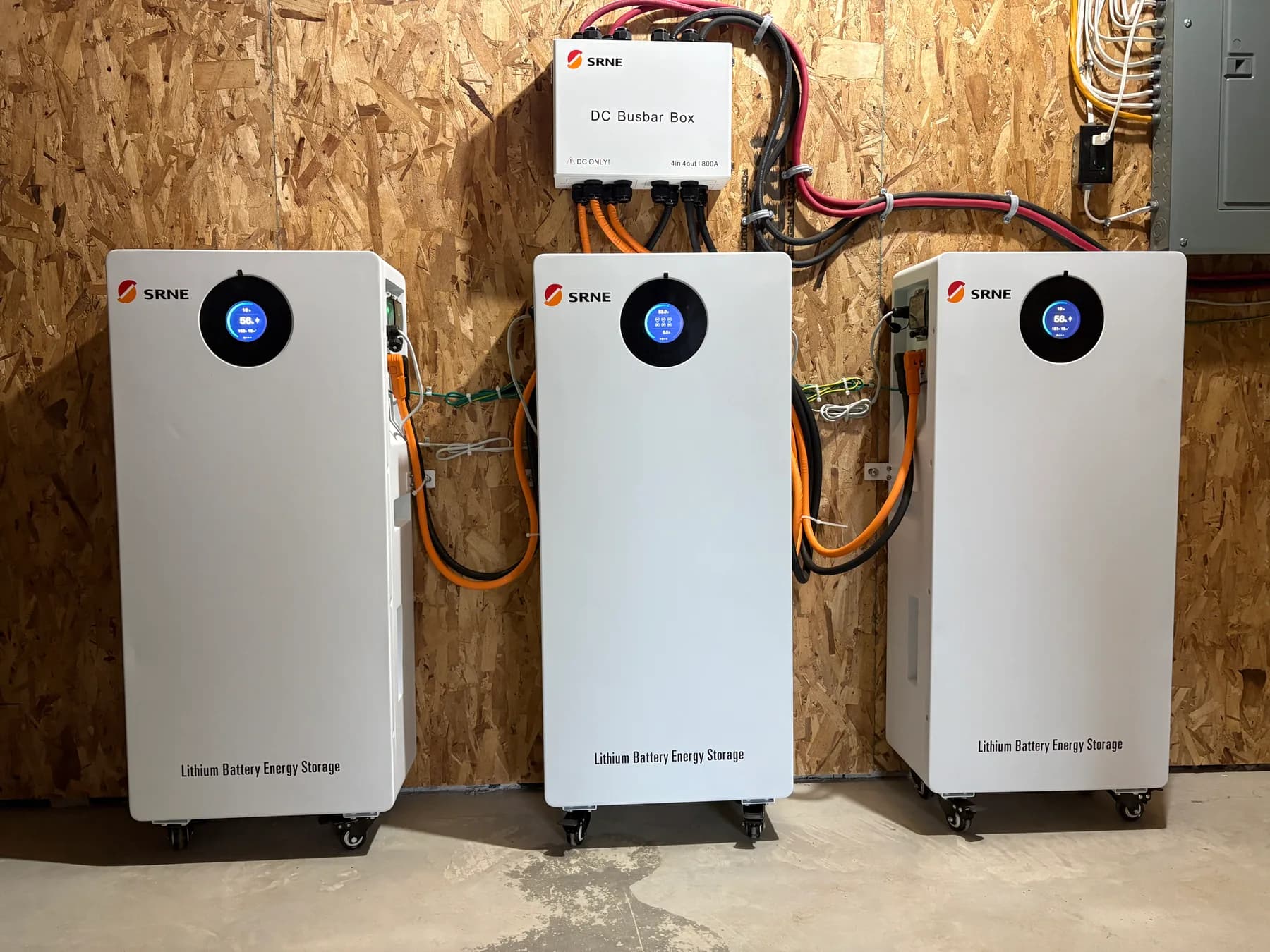
Since we sell only lithium iron phosphate (LFP) batteries, we will discuss only those. LFP batteries have the safest chemistry in the world, which prevents explosive chain reactions. Their exceptional safety is why LFP batteries are the most widely used in solar systems, among other applications. They have a high cycle life: 8000 cycles in the case of our 16.07Kw SRNE EOS15B battery. They handle partial charging well and have a low self-discharge rate.
Lithium batteries are managed by a BMS, which stands for Battery Management System. It is, in a sense, the brain of the battery. It is not the inverter that controls battery charging. The BMS asks the inverter to supply the required charge.
The BMS controls:
• Overcharging
• Excessively deep discharge
• Overcurrent
• Short circuits
• Overheating
• Monitors each cell individually
• Corrects imbalances
• Stops charging below 0 Celsius, and charging/discharging above 55–60 Celsius.
Lithium batteries cannot be recharged when the temperature reaches 0 Celsius or below. However, they can continue to supply energy until they are completely discharged. This factor must therefore be taken into account when choosing batteries.
Batteries
However, this does not mean you cannot use lithium batteries at your cottage if it is unheated. You simply need to configure the inverter to ask the BMS to stop discharging at 50% or 60%, or shut down your entire system after bringing your batteries down to 50% or 60% (very important). When you return to your cottage, simply warm the area where the batteries are located to above 0 Celsius so they can be recharged.
LFP battery ageing:
1) High temperature:
This is the main cause. At 40 Celsius, a battery can age 2 to 3 times faster than at 20C. 2) Storage at a high state of charge:
When an LFP lithium battery is stored at 100%, its chemistry degrades faster. At 25 C:
• Stored at 50%: a loss of 2 to 3% per year.
• Stored at 100%: a loss of 4 to 6% per year.
At 40 C:
• Stored at 50%: a loss of 5 to 8% per year.
• Stored at 100%: a loss of 10 to 15% per year.
3) Natural ageing:
Over time, batteries lose cyclable lithium and capacity, and their internal resistance increases. Degradation is faster if they remain at 100% charge for too long. Poor balancing of the internal cells affects their life…
Conclusion:
If you keep the ambient temperature below 30 degrees Celsius, do not leave them charged to 100% for too long, and do not store them at 100% charge, they can easily last 15 to 20 years. Suppose you discharge them to 50% and recharge them to 100% every day: 365 days divided by 2 (.5 of a cycle) gives 182.5 cycles per year. 8000 divided by 182.5 cycles gives 43.8 years of life. Your battery will reach the end of its life through natural ageing, rather than through the number of cycles used. Another advantage of lithium batteries is that they are not affected if they are not recharged to 100% every day; they can be discharged by 80–90% without a problem, with very little impact on their service life.
Batteries
AGM and GEL Batteries
Both are sealed lead-acid (VRLA) batteries, but their internal composition is very different.
AGM (Absorbent Glass Mat)
• The electrolyte is absorbed in fibreglass separators.
• Very good starting current. Ideal for applications that require power surges.
• Faster recharging.
• Performs well in the cold, but suffers in heat.
• Less tolerant of deep discharges, so they have a shorter cycle life.
• They are the least expensive.
GEL
• The electrolyte is gelled with silica.
• Lower discharge current, unsuitable for starting motors.
• Slower recharging, slow and deep discharge. Requires a suitable charge controller.
• Excellent resistance to deep discharges. Lasts 2 times as long in number of cycles as an AGM battery.
• More sensitive to extreme cold, but very stable in heat.
• They are more expensive than AGM batteries, but last longer. Conclusion:
AGM and GEL batteries are more affected by deep discharges; they can be recharged below 0 Celsius. LFP lithium batteries last 3 to 6 times longer than a GEL battery, but cannot be recharged below 0 C.